I Thought Being Ready Was Enough to Get Promoted
Why performance matters, but isn’t the whole story.

I used to think I understood how promotions worked. Do good work. Take responsibility. Solve difficult problems. Be the person others can count on. Eventually, someone notices and gives you a bigger role.
At different points in my career, I felt ready for that next step. I could point to what I’d delivered, the problems I’d solved, and the responsibility I was already carrying. So when the next step didn’t happen, it was tempting to focus on a single question: What else do I need to prove?
I’ve changed my mind about that question.
Sometimes I probably wasn’t as ready as I thought I was. But I’ve also learned that being ready for a promotion and being in a position to get one are not the same thing. Your performance is one part of it. The people around you, the needs of the business, and the state of the company are other parts. And they don’t always line up.
Doing your job well is the starting point
Of course performance matters. But the further you grow, the less useful it becomes to measure your value by how many problems you personally solve.
Can you bring solutions instead of just escalating problems? Can you figure things out when there’s no obvious path? Can you stay calm when everyone else is under pressure? Can you disagree with someone without turning it into a personal fight? Can you remember that the people around you are human, not just their job titles?
Those things count. In my experience, they often count more than we want to admit.
There is also a difference between being the person everyone needs to get things done and being someone who makes everyone else more effective. If everything depends on you, you’re valuable, but you’ve also become a bottleneck. A bigger role usually requires a different kind of contribution: better decisions, more independent people, fewer recurring problems, and less chaos for others to deal with.
And yet, you can do all of that and still go nowhere.
Your promotion has to make sense to other people
This was one of the harder lessons for me.
We often talk about promotions as if the company is supposed to reward the person who has worked hardest or delivered the most. But the people making the decision are usually looking forward, not backward.
What problem does promoting you solve? What becomes possible if you take on that role? What responsibility can someone else finally let go of? How does the team or department benefit? Why now?
At senior levels, your manager and their manager have their own goals, pressures, and commitments. They need to believe that giving you more scope will help them deliver. That’s not automatically selfish or political. It’s how an organization decides where to put responsibility and money.
A promotion has to be good for you, but it also has to make sense for the organization. If only one side sees the benefit, you might have a difficult case to make.
That doesn’t mean you should become agreeable just to move up. It means understanding what the business actually needs, rather than expecting your good work to speak for itself.
Your manager is part of the equation, whether you like it or not
Let’s say you’re performing well and your manager genuinely wants to see you grow. That still might not be enough.
Your manager needs the credibility and influence to make a case for you. They need to understand how decisions are made, know who needs convincing, and be willing to spend some of their own credibility backing you. If they struggle to work with their own leadership, or their judgment isn’t respected, your promotion can get stuck even when they support it.
This isn’t always obvious from your seat. You see the relationship you have with your manager. You don’t necessarily see the relationships they have with everyone else.
Then there’s the wider organization. Your peers need to trust you. People outside your department need to know what you contribute. The people approving a promotion need to picture you doing the next job, not just doing your current one very well.
I used to underestimate visibility. I don’t mean being the loudest person in every meeting or turning every achievement into a LinkedIn post. I mean that if only your manager can explain your impact, you’re relying on one person to represent you. That’s a fragile position.
And yes, relationships matter. Being liked helps. But being trusted matters more. You need to be someone others can disagree with, work through problems with, and rely on under pressure. You don’t have to be compliant with every decision. You do need to know how to challenge a decision without making collaboration harder for everybody.
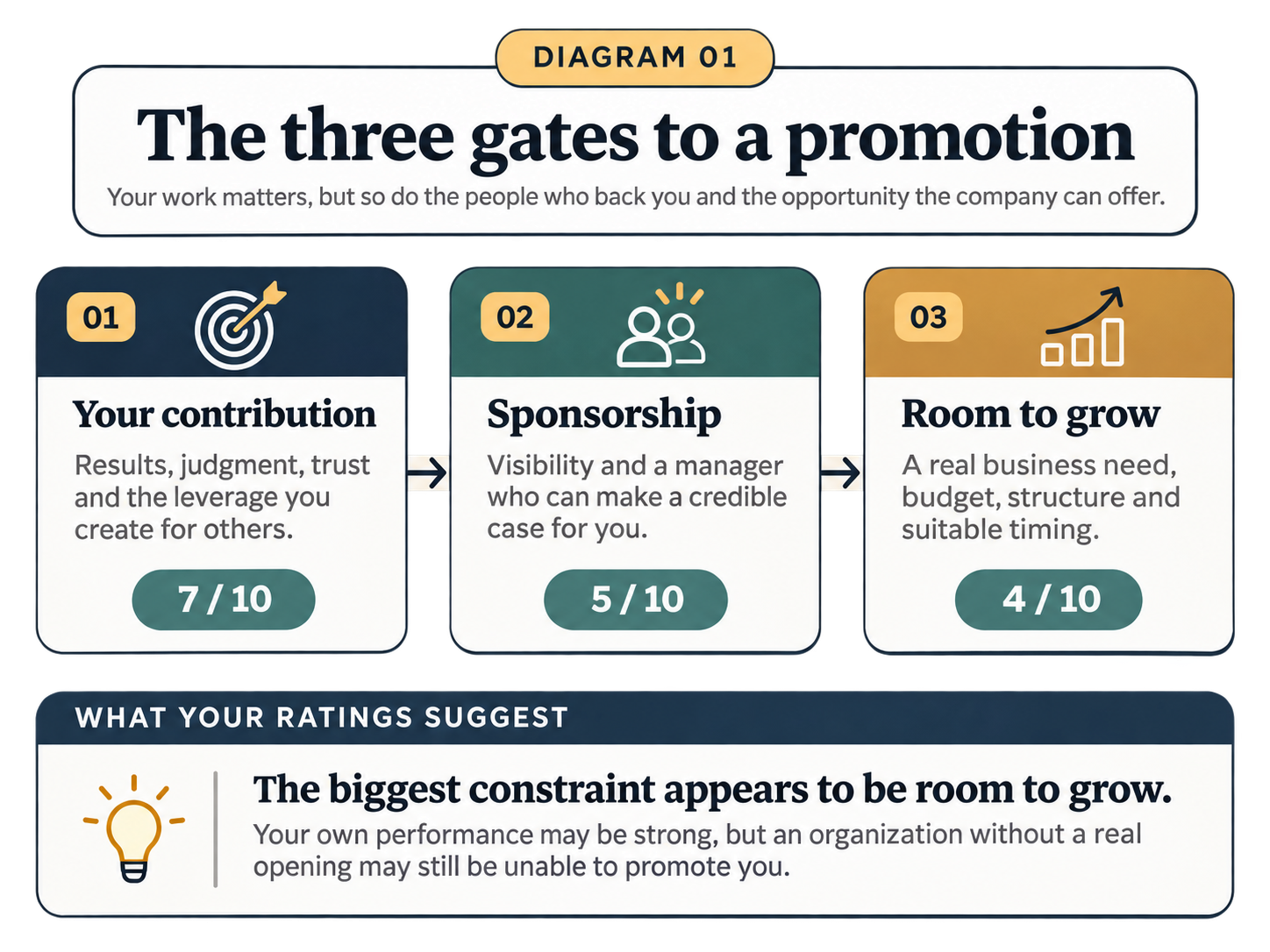
A struggling company changes the rules
This is the part I think gets overlooked the most.
Imagine a company that isn’t doing well. Revenue is under pressure, priorities keep changing, decisions take too long, and people are tired. Management is no longer thinking primarily about building the next version of the organization. They’re trying to keep the current one running.
Some leaders are protecting teams. Some are protecting budgets. Some are protecting their own jobs. Often they’re doing all three. They may have families, financial commitments, and responsibilities that make taking risks feel much more expensive than it did a few years earlier.
It’s easy to look at that from below and assume nobody cares, or that the people in charge are simply bad at their jobs. Sometimes the decisions really are bad. But sometimes you’re watching capable people operate under pressure, with very little room to move.
The result can look the same: everyone is busy, everyone is rowing, and yet the organization isn’t getting very far. The direction is unclear. People become defensive. Nobody wants to promise a promotion, create a new position, or make a bet they might have to explain six months later.
When a company is focused on survival, personal career development can become a secondary concern. Not because your work means nothing, and not necessarily because anyone has something against you. There may simply be no energy, money, or organizational appetite to make your next step happen.
You cannot always outwork that situation.
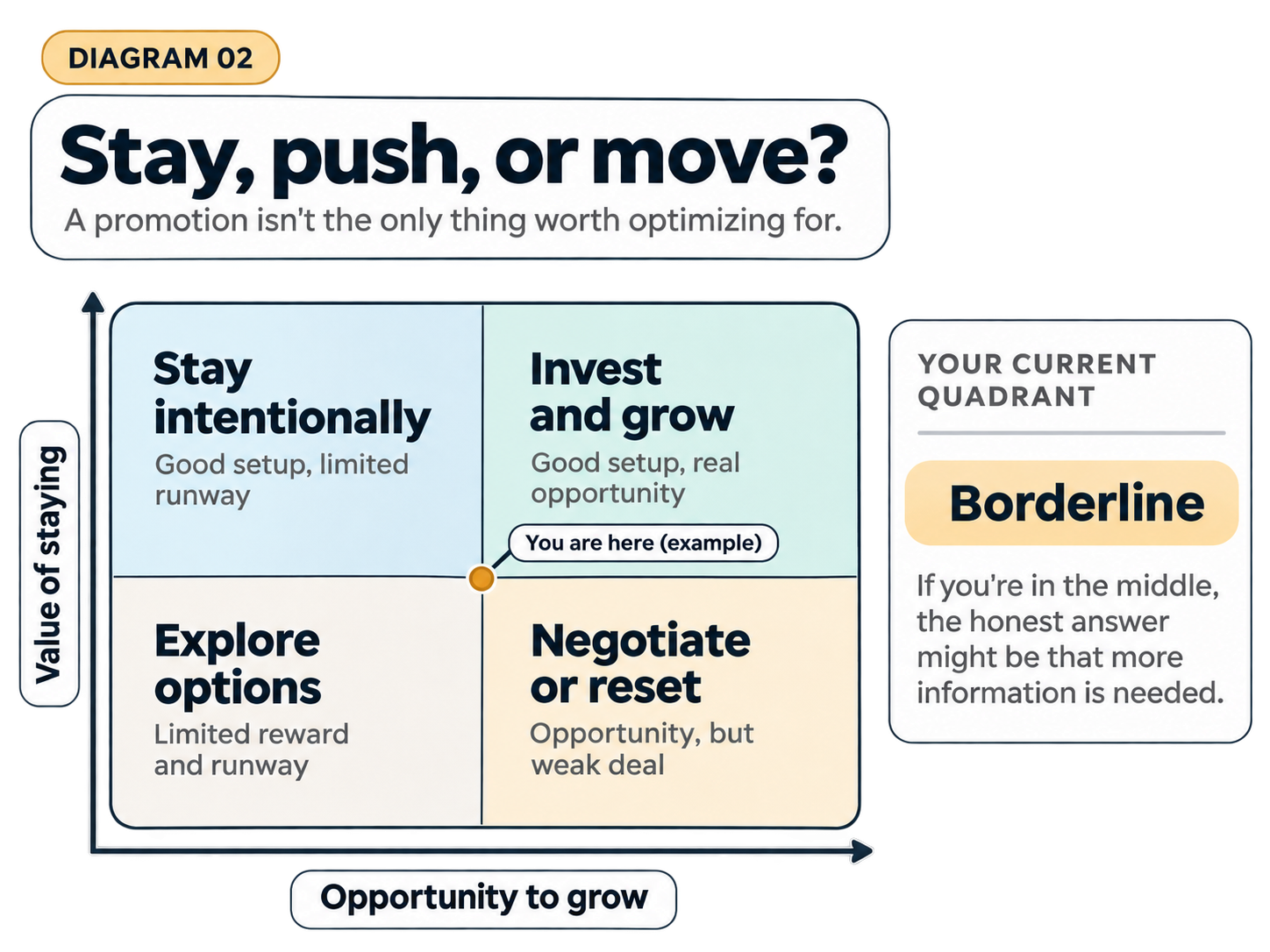
Staying can be smart. Staying by default is different.
This is where I think the conversation about promotions should become a conversation about choices.
Maybe you’re not getting promoted, but you have a good salary, a bonus, flexibility, remote work, a manager who leaves you room to operate, and a life that works well with your job. Those things have value. A title isn’t the only thing worth optimizing for. There are periods when staying exactly where you are is a perfectly sensible decision.
But consider the opposite. Your salary is below what you could earn elsewhere. There’s no realistic role to grow into. You’re not learning much. The company is struggling, and the benefits of staying aren’t particularly strong either.
At that point, what exactly are you waiting for?
I don’t think changing jobs should be the automatic response to a missed promotion. Leaving comes with risk. You can trade a frustrating situation for a worse one. And staying gives you things that may not show up in an offer letter: familiarity, autonomy, trusted relationships, time for your family, or simply less stress.
But staying has a cost too. You can spend years waiting for a company to create an opportunity it has neither the ability nor the intention to create.
The important thing is to make the trade-off consciously, rather than confusing hope with a plan.
The questions I’d ask now
If I felt ready for a promotion today, I wouldn’t start by asking only whether I deserved it. I’d want a clearer answer to a few questions.
About me: Am I already showing the judgment and impact expected in the next role, or am I mostly doing more of my current job?
About the business: What real problem would my promotion solve, and does that role actually need to exist?
About my manager: Can this person advocate for me effectively, and are they prepared to do it?
About visibility: Who beyond my immediate team understands my work and trusts me with more responsibility?
About timing: Is the company investing in growth, or mostly trying to get through the next quarter?
About my options: What am I getting by staying, and what am I giving up?
I’d also ask for specifics instead of reassurance. What would the next role require? What evidence is missing? Who needs to agree? Is there a realistic opportunity in the coming months? If the answers keep changing or remain vague, that’s information too.
These questions won’t guarantee anything. They can, however, help separate three very different situations: you’re not ready yet; you’re ready but need stronger support; or you’re ready and the opportunity simply isn’t there.
Each calls for a different decision.
A promotion isn’t a verdict on your worth
I still believe you should do excellent work. Be useful. Take responsibility. Keep your head cool. Treat people like people. Figure things out when the situation gets messy.
But I’ve stopped believing that doing those things creates an obligation for someone else to promote you.
That isn’t an excuse for unfair decisions, favoritism, or weak management. Those things exist, and they deserve to be called out. It’s simply an acknowledgment that a career unfolds inside a system you don’t fully control.
Your job is to improve what you can influence, understand the rest as clearly as possible, and decide whether the exchange still works for you.
Sometimes the answer is to improve. Sometimes it’s to have a harder conversation. Sometimes it’s to enjoy the good position you’re already in. And sometimes it’s to leave.
I wish I’d understood that distinction earlier.
Discussion about this post